
A Mill of Many Names
In 1936, George Holden, a farmer from Lansing, donated a mill pick—used to sharpen millstones—from the Jim Ford Mill to the newly re-established DeWitt Historical Society, now The History Center in Tompkins County. Decades later, Robert and Margery Clauson of Alpine, New York donated two conveyor buckets from the Old William Haskin Grist Mill, along with photographs and related documents. While researching these materials for an upcoming exhibit, “The Power of Water”, we made a surprising discovery: these mills were, in fact, one and the same.
The mill stood on Salmon Creek, about three and a half miles above Ludlowville. It was built in 1819 by Ambrose Bull and later acquired by Abel Haskin, who brought his family to Lansing in 1836. When Abel retired in 1853, he passed the business to his son William, who operated the Salmon Creek Flouring Mill until his death in 1869. The mill was then purchased by James Ford, the son of a Freeville miller, who renamed it the Lansingville Mill. Ford modernized the operation, installing a 63-foot-long, four-foot-wide iron flume from Union Springs and expanding the business with new machinery, including equipment that used conveyor buckets to move grain and flour through the mill.
After Ford’s death in 1901, the property was eventually acquired by George Holden. Holden later sold the mill’s iron flume to William Howser, owner of a mill on Gulf Creek in North Lansing, before dismantling the Salmon Creek mill in 1928. Before it was torn down, however, Holden—or possibly his son Merle—carefully documented the site. Photographs captured the mill, its stone-arch water outlet, and its French-imported millstone, and two galvanized metal conveyor buckets were preserved.
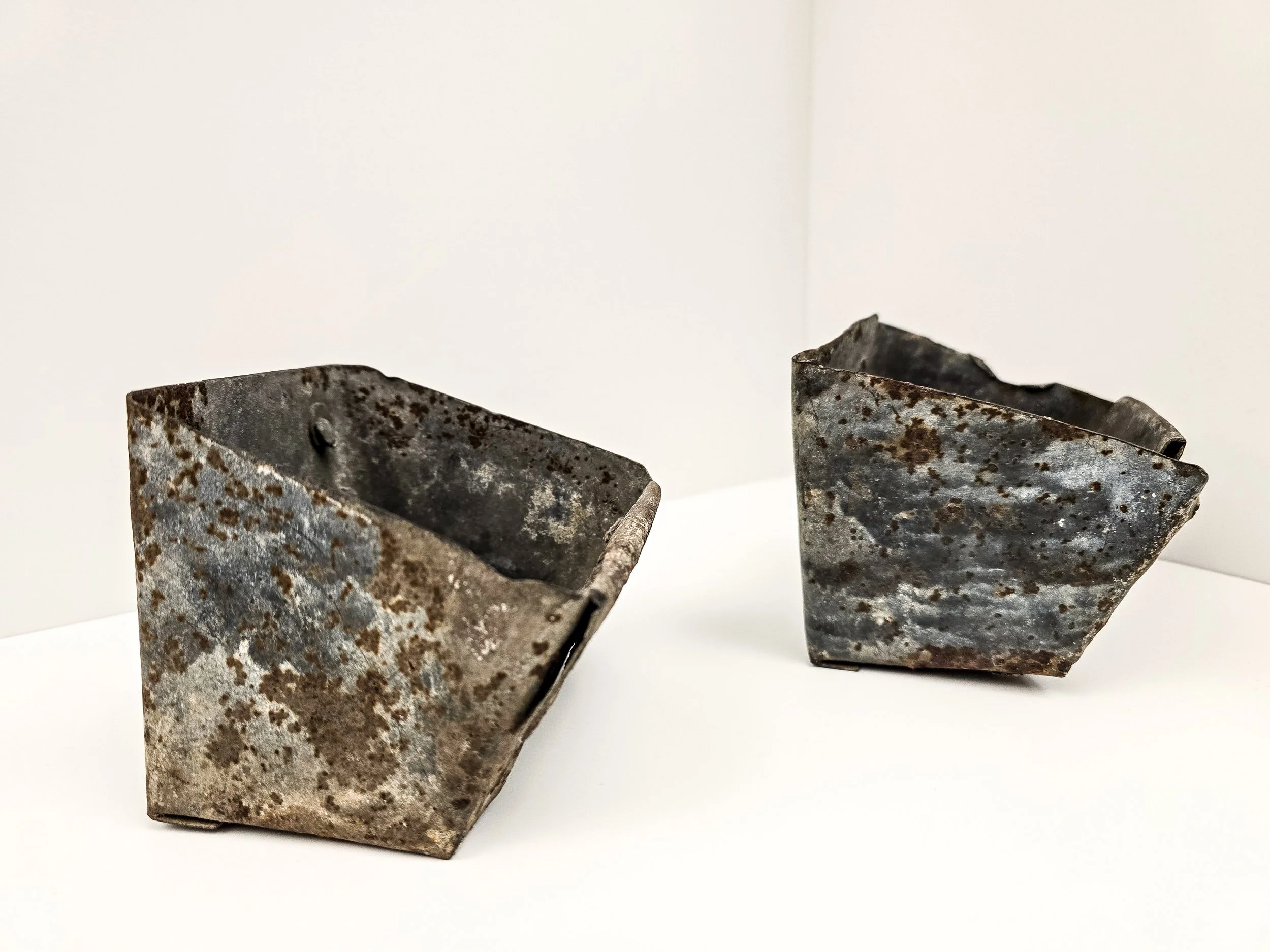
Conveyor Buckets from the Mill of Many Names
At some point, these photographs and artifacts came into the possession of Robert Clauson, a Tompkins County tax assessor and dedicated local history collector. In the 1980s, Clauson donated the materials to The History Center, along with documentation tracing the property back to William Haskin. Together, these objects—once understood as belonging to separate mills—now tell a fuller, more connected story of a single site that evolved across generations, owners, and names.1
Together, stories like this—pieced together from artifacts, photographs, and decades-old donations—form the foundation of The Power of Water: A Dam Good Exhibit. What began as a mill pick, a pair of conveyor buckets, and a handful of photographs became, through months of careful research, a richer understanding of how water shaped industry, innovation, and daily life in Tompkins County. We invite you to see the finished result of this work for yourself when the exhibit opens during First Friday Gallery Night, February 6, from 5–8 p.m. Join us to explore how water powered communities, transformed landscapes, and continues to connect the many layers of our shared local history.
1. John H. Selkreg, Landmarks of Tompkins County, New York, D. Mason & Co. Publisher, 1894, 63, 346; Hamilton Child, Gazetteer and Business Directory of Tompkins County, N.Y., 1868, Syracuse: Journal Office, 1868; “Lansingville,” Ithaca Journal, April 4, 1914, 9; “North Lansing Man Moves Large Flume,” Ithaca Journal-News, December 10, 1925, 16; DeWitt Historical Society, Deed of Gift from Mr. and Mrs. Robert Clauson, December 28, 1982.
Written by Eve Snyder PhD, Historian, and Edited by BrierMae Ossont, Community Engagement Manager
