Get Involved

in History Happenings

  • Exhibit Hall Docents and tour guides are an integral part of THC community engagement. They are a knowledgeable, conversational, and uplifting presence in our museum front in the Ithaca Commons.

  • The History Center is developing a series of walking tours in and near Ithaca Commons. If you have a flair for the dramatic and a well supported voice, consider becoming a tour guide!

  • Whether you’re looking to write blog posts or support exhibit development, create social media posts or map census data with HistoryForge, the History Center has something for you.

  • Volunteers in the Archives and Collections have gentle hands and detail oriented minds. They are patient - history takes time!

BrierMae Ossont BrierMae Ossont

When a Log is Not a Log: Behind the Scenes in Exhibit Research

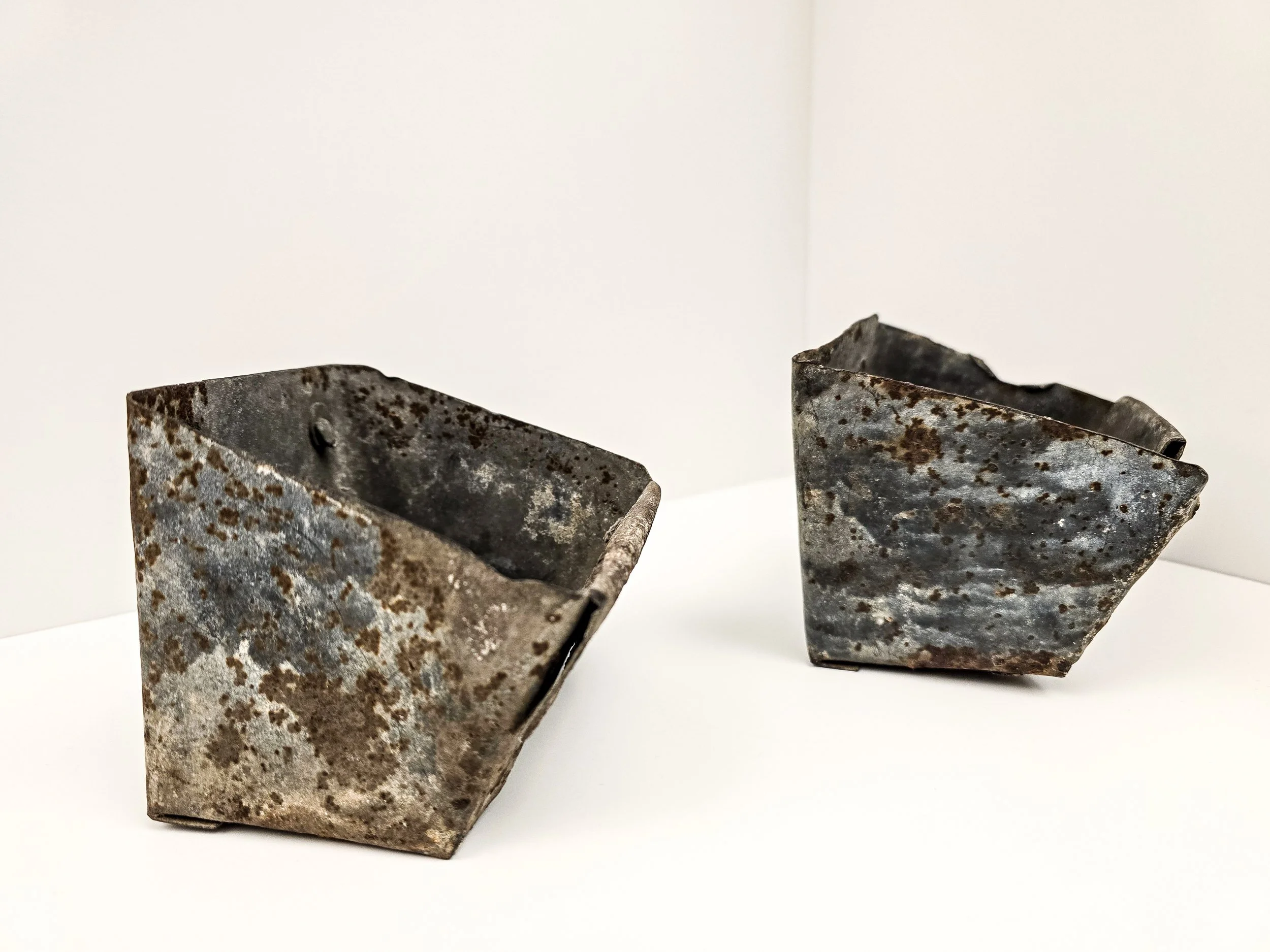
Wooden Water Pipe, 41.01

The shelves are metal and packed tightly together in the collections room at The History Center. Near an oversize red dollhouse, careful grey boxes of quilts, and hand-hewn farm implements is what appeared at first glance to be a log. It was an old log, but it wasn’t any old log, it was part of Ithaca’s early infrastructure: its first public water supply.

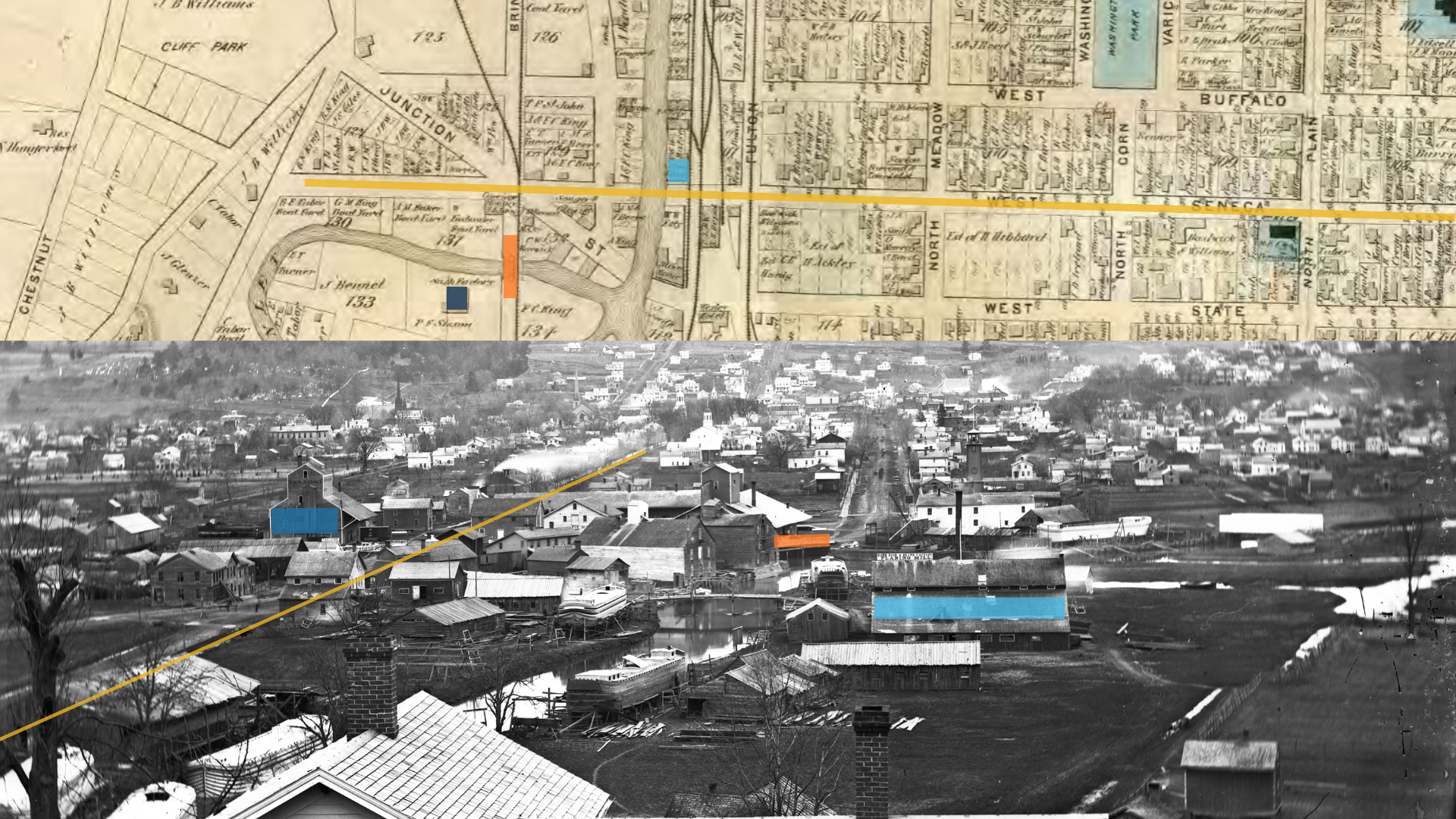
The log was part of an underground pipeline laid in 1822 by Phineas Bennett and his son, Phineas Bennett Jr., owners of a grist mill on Six Mile Creek above Aurora Street located at what is now 401 E State St, the previous location of The History Center. Made from hollowed out wooden logs, these pipes carried water from the Bennett’s mill dam down Owego St, or State St as it is currently known, into the village center. They did not supply water to homes and businesses, instead, the water was piped to cisterns, underground receptacles that collect and store water, at the corners of Aurora, Tioga, Cayuga and Geneva Streets where it could be used to fight fires.

The peril of fire was such a concern to the newly incorporated village, that fire protection was written into its incorporating Act in April 1821. Among other things, the Act of Incorporation empowered the Village’s initial elected officials to procure “fire engines and other utensils for extinguishing fires” and appointing a company of firemen.

That fall, Village trustees provided additional funds to expand its fire fighting capacity. They contracted with both Phineas Bennett as owners of the mill’s water rights, to build the pipeline and cisterns, and in the case of fire, to ring a bell to alert firefighters and residents. An early village ordinance required that all buildings have a leather bucket and a ladder so its inhabitants could help with fire protection. In the case of fire, fire fighters would pull their engines, basically pumps on wheels, by ropes to the fire and village residents would form a bucket brigade from the nearest water source, a cistern, well, or creek, to be pumped onto the flames. Use of the wooden pipes continued until sometime after 1857 when the mill dam was wiped out by that year’s flood. The responsibility for filling the cisterns went to the newly established village water system.

The wooden pipes were rediscovered in 1885, by village workers excavating State Street who left them untouched, and again (at least) in 1941, following a water main break at the intersection of State and Aurora Streets. At that time city workers removed a section which was donated to The History Center’s predecessor, the DeWitt Historical Society and this log took on a new life as an object in our collection. Since The History Center’s move in 2018 it has sat on a shelf in storage with other more recognizable historical objects, leading staff to ask the question, why do we have a log in our collection?

I started my research in the catalog. The original paper records have been carefully transcribed over the years, digitized as computer files, and now live online in an evolving public database. Not all of the 20,000+ objects in the History Center's collection are donated with a wealth of provenance. Whatever we have, goes in the catalog. I looked up the log-object to find out that it was purported to be: “Hollowed from a log and used in early days to carry water to fire cisterns on State St. Unearthed at the corner of State St. and Aurora Street.” This was exciting to me, but not enough support the upcoming exhibit.

The last piece of information in the catalog was the donor's name, "George D. Carpenter." I turned to Tompkins HistoryForge where I found out that George D. Carpenter was the Supervisor of the City of Ithaca’s Water Department at that time. It made sense that as the head of the water department he would have the authority to remove a piece of the pipeline and donate it, but I still had questions. Why did he remove and donate it when others hadn’t in the past? To answer this question I turned to the Ithaca Journal. Searching old issues for evidence of Carpenter’s association to “the DeWitt” as The History Center was then called, or at least his affinity for history, I initially came up empty. Rethinking my search tactics I focused my search and search terms on the wooden pipe itself. This time I did not come up empty handed. An article from October 18, 1941 titled “Flood Exposes Ancient Pipe” told of the finding of the wooden water pipeline, the suggestion by City historian John G. Brooks, that it was part of the city’s initial water line laid to help fight fires, and that part of it was removed to be given to the historical society. In addition to serving as City Historian, John G. Brooks was the president and one of the founding members of the newly revitalized DeWitt Historical Society.

Piece by piece, the story of the wooden pipe came together. The unassuming log on our shelf is much more than a curious artifact—it is a rare surviving piece of early Ithaca engineering, a tangible connection to the ingenuity and communal effort that protected the young village from disaster. Its rediscovery highlights not just the evolution of local infrastructure, but the long tradition of community members who recognized the importance of preserving our shared history.

You can help continue the preservation of these objects and their stories. As the new year and years after unfold we'll be working to make our catalog public through the new database system. You can find Bennett's pipe there, and the new system will enable me to include references to contextual information for you and other researchers, as well as images of the item itself. You can support this work throughout December by donating, and donors will help us select what collections to digitize first! This work snowballs, enabling better and easier research for exhibits, classrooms, and strangers far from home.

Thanks for reading, donating, and special thanks to the numerous volunteers who have transcribed historical census records as part of our HistoryForge project since 2016.

Support Our Work

Written by Eve Snyder PhD, Historian, and Edited by BrierMae Ossont, Community Engagement Manager

Read More
BrierMae Ossont BrierMae Ossont

The First Look At Online Collections - A Public Access Catalog for the History Center

The History Center in Tompkins County has officially launched the first phase of our Online Collections Catalog, a new tool that brings parts of our archives, photographs, maps, and artifacts onto the web for anyone to explore. You can take a look here:

THE CATALOG

This is a milestone that has been years in the making — and it represents the beginning of a much larger journey to make our collections accessible to the public in a way they’ve never been before.

What is a “Public Access Catalog”?

A public access catalog is exactly what it sounds like: a searchable digital gateway to a museum or archival collection. It allows you to explore what we hold in our vaults, even if you can't visit the History Center in person.

On our new online catalog, you can:

  • Browse highlighted photographs and artifacts

  • Search by names, subjects, and places

  • Discover items connected to local families, neighborhoods, and historic events

  • See early versions of finding aids for archival collections

  • View digitized materials when available

Right now, you’ll notice that only a portion of our collection is available. That’s because building a public catalog is a massive undertaking — and this first phase gives you just a peek at what’s ahead.

Donna Eschenbrenner, Director of Archives and Research Services, and Cindy Kjellander-Cantu, Curator, have been hard at work cleaning and organizing the data for our 100,000+ photographs, 400+ archival collections, 1,200 maps, 20,000+ objects, 200+ oral histories, and more. In the coming year they’ll continue to grow the catalog and begin the process of digitizing collections.

It is a massive undertaking.

There are several ways you can get involved. The first is to donate. Forty percent of the History Center’s funding comes from individual donors - which means individuals like you have enabled this amazing project. The second is to volunteer. Keep your ears out in the coming months for invitations to assist with the digitization process! The third way to contribute is to explore. Click around the catalog, practice searching, and let us know what you find!

As the public catalog begins to represent the artifacts and stories kept at the History Center, teachers will be able to teach local history without expending the budget to leave the classroom, families will be able to find their roots in Tompkins from afar, and researchers who otherwise are not able to join us in the Commons will have an entry point to our shared local history.

Read More
BrierMae Ossont BrierMae Ossont

The Treasure is Out There, Something For Everyone

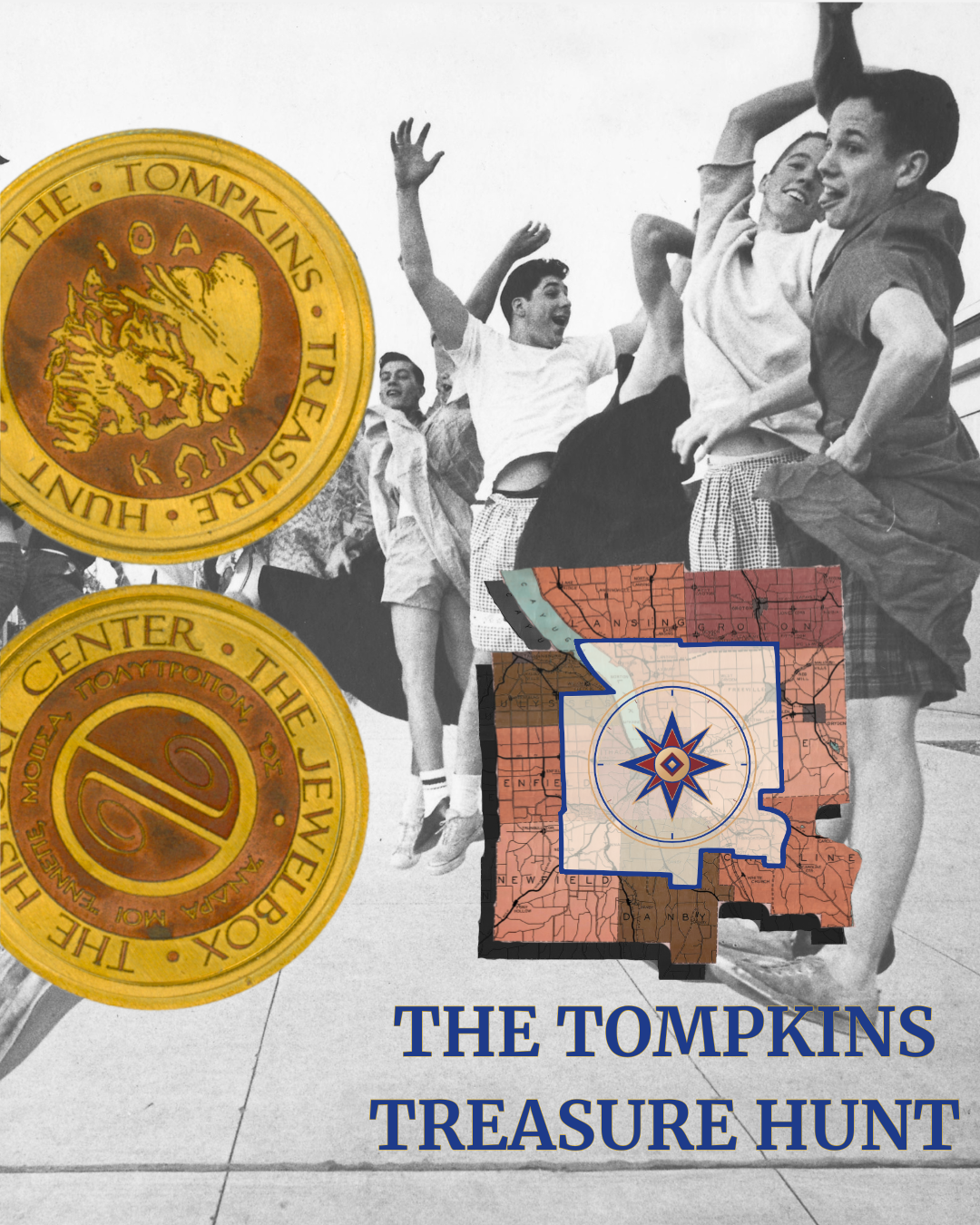
By now you’ve heard of the Tompkins Treasure Hunt, a fundraiser for The History Center in Tompkins County. What you may not know is that we’ve hidden $10,000 worth of jewels somewhere in the county—waiting to be claimed by the very first finder.

This sparkling prize has been provided by our sponsor, The Jewelbox, where every piece is a conversation piece.

How It Works

  • Register at thehistorycenter.net/tompkins-treasure

  • Receive puzzles starting September 6 at noon

  • Solve clues tied to Tompkins County history and culture

  • Uncover the location and win the treasure!

The hunt is designed by David Wilson, a master puzzle-writer whose creations tie together history, local culture, and clever observation. Past puzzles have sent hunters to a café window full of music posters—where the “out-of-time” 1945 jazz flyer held the next QR code clue. Hunters used the power of observation to connect the poster to the history themed treasure hunt. No digging or climbing required—just a curious mind and a smartphone with a QR reader. The hunt is self-paced, as soon as you solve one puzzle, you can move onto the next. Finish by Monday evening or take all week! But hurry, only the first person to complete the hunt receives the $10,000 jewel prize. All other finishers will receive a special coin created by the Jewelbox for this occasion.

Hunt Solo or as a Team
You can join the hunt on your own, but we encourage friends and families to join together, register just once, and play as a team. After registering, share your team list so everyone can access the Tompkins Treasure Facebook group for updates, community, and a little friendly competition. Here’s a helpful hint, use code “TEAM” for 10% off of registration.

Family-Friendly Fun
While kids can’t claim the $10,000 treasure on their own, we’ve partnered with the Ithaca Children’s Garden to host a special Children’s Treasure Hunt on September 6 at 9:30am. Perfect for ages 8–12 (and younger with adults), this mini-hunt will send kids exploring the garden, each leaving with a gem of their own.

Kick-Off Celebration
Join us at The Jewelbox on September 6 at 11:00am for live music, food trucks, and festivities.
At 12:00pm, the first puzzle will be released via email to all registered participants—and those at the kick-off will get a limited hard-copy version.

Ready to Hunt?
The treasure is hidden. The puzzles are waiting. The only question is: will you be the one to find it?

Read More
BrierMae Ossont BrierMae Ossont

Reading “Culinary History of the Finger Lakes'“ by laura winter Falk, PhD

You’re invited to join us on July 5 at 4 pm for a wine tasting and book celebration. Get your tickets HERE.

I have a particular soft spot for food history, many actually, earned by eating my way through my grandmother’s family cookbooks. Whenever I move to a new area I do a thorough survey of new and old eateries, paying special attention to those with localized names or decades old storefronts. I map neighborhood fruit trees and patches of spring greens. I scour the shelf at the local library for regional cookbooks and take notes in my kitchen journal.

What a gift it is then, to receive a copy of Culinary History of the Finger Lakes on my desk just a month before I prepare to move my family to the Fall Creek Neighborhood in Ithaca City. Each chapter of Dr. Winter Falk’s book explores a new time period and the tastes that developed alongside our towns and cities. There are “era-appropriate” recipes that share how to make historic dishes in a modern kitchen, and each recipe is paired with a currently available wine from a local winery. Dr. Winter Falk has even thought to accommodate my sober partner and picky friends by including ciders, cocktails, and nonalcoholic beverages with her recommendations.

I’m making my way through the book in preparation for a wine tasting with Dr. Winter Falk, where she’ll introduce us to concepts in her book, and hopefully will help refine my pallet so I can blend in with the locals in my new home. Beyond being a author and experienced educator, Laura Winter Falk is a Certified Sommelier with the Court of Master Sommeliers.

The first recipe I’m preparing to try from this book is “Quincy Exchange Crab Deviled Eggs.” This recipe is from the prohibition era, but that doesn’t mean it was enjoyed sober (find out more about that on The History Center’s Prohibition Tour) and it’s paired to a cocktail made with McKenzie Distiller’s Reserve Gin. Unlike the majority of the population, I’m a deviled egg skeptic, but something about the crab salad filling made with mini sweet peppers makes me want to get out of my comfort zone. And the prohibition-era sentiment that finger foods help keep a party long and light is one I can get behind.

Image from Culinary History of the Finger Lakes of “Quincy Exchange Crab Deviled Eggs”

If you’d like your own copy of this book it will be on sale at Tasting Culinary History with Laura Winter Falk on July 5 at 4 pm. You’re invited to join to sip, listen, and learn. You can get your tickets HERE.

Read More
BrierMae Ossont BrierMae Ossont

Guest Review: “Unionizing the Ivory Tower” by Al Davidoff

This article was written by Amira Shimin, a student-docent in the Exhibit Hall.

The unionization and the fight for a living wage for Cornell workers spanned over a decade and involved thousands of workers, their relentless dedication and work, countless hours, allies, and strategies. In Al Davidoff’s, Unionizing the Ivory Tower, he details this process through all its steps. Davidoff, who started as a student at Cornell in its school of Industrial and Labor Relations became a custodian to help unionize the Cornell workforce and went on to become the union’s first president.

The book maps the journey of unionization from the earliest efforts to winning the vote to negotiating the first contract to maintaining that contract and to continuing to demand more. Davidoff highlights the difficult battle in winning and maintaining a union. It seems as if after every major win, there is only more to fight for. That in its essence is organizing. The battle is never over.

Davidoff describes the variety of strategies employed by UAW 2300 in their fight for better wages and working conditions. The strategies are unique, adaptable, and persistent. The UAW’s success was in part largely due to the fact that the union hit Cornell in every way they could. Davidoff writes about rallying an originally unsupportive workforce in supporting the first ever arbitration hearing and winning, of building allies in the community by electing a supporter of the union to become Ithaca’s mayor and getting a supporter of the union on the board of trustees. He writes about clever tactics like instructing dining hall workers, who were trying to get a stipend for non-slip safety shoes, to bring their stinky shoes to a collective bargaining meeting to disturb management. The UAW 2300 were relentless. Davidoff writes about the time they mass organized to direct all freshman students moving in, to a parking lot where union members would give a speech about how Cornell did not pay them a liveable wage and informing the incoming students and their family’s about the union’s fight.

One of the most important tenets of this book was solidarity. It was solidarity that won over countless times and it was solidarity that created the union, that kept it expanding, that ensured that the union would continue to win and gain power. The examples of solidarity are moving. From getting a primarily white racist membership base to vote to go forward with the first arbitration of the union, an arbitration that involved a black worker, to getting a more than substantial strike fund from workers across all other departments when only dining workers were on strike, to singing solidarity forever as members awaited the union vote.

The central message of the book is hope and that is what Davidoff ends by urging his readers to have. He emphasizes the importance of class solidarity in fighting racism, division, and bigotry. He notes the current disillusionment with the white working class that has turned against their own interests and turned towards racism and bigotry. But, Davdidoff urges the reader to reconsider. He emphasizes the importance of solidarity in fighting this racism and division. He brings up the UAW at Cornell, a largely white conservative membership that was able to rally in support of progressive ideas countless times. While the right wing relies on despair and powerlessness to gain support, labor should focus on hope and power, Davidoff argues. To effectively combat division, unions need to cultivate knowledge about workers' circumstances, foster agency to alleviate feelings of powerlessness, build community to create empathy, and achieve regular victories that boost the confidence and hope of workers.

The UAW 2300 is not just a part of Cornell’s history, it's part of Ithaca’s. The start and the development of the union at Cornell represents a central part of Ithaca's history and demonstrates how far community can be in enacting change and how community building can create power that can change the lives of the working class.

As of May 29th, there are just 4 copies left available at The History Center in Tompkins County

Read More