
When a Log is Not a Log: Behind the Scenes in Exhibit Research
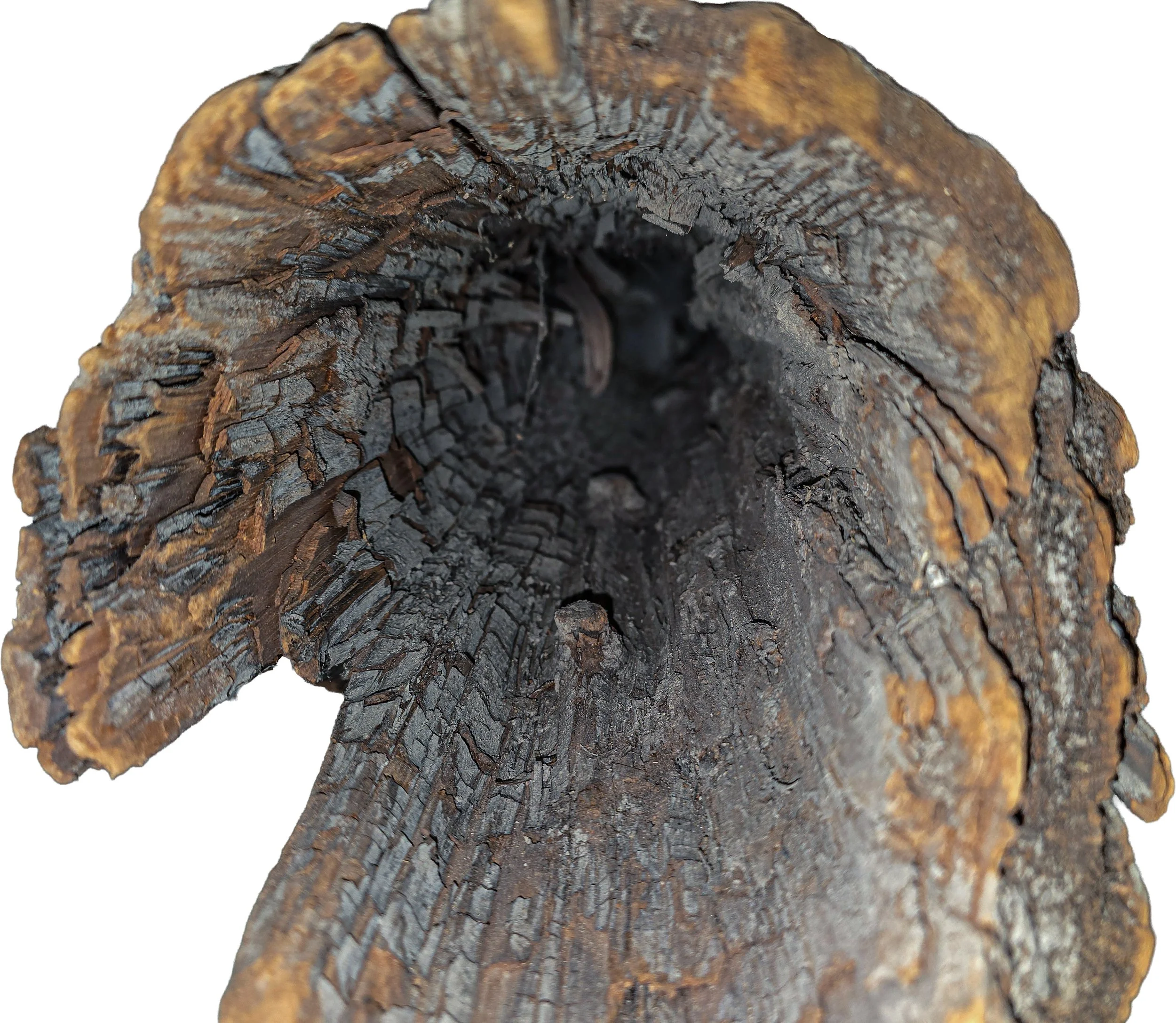
Wooden Water Pipe, 41.01
The shelves are metal and packed tightly together in the collections room at The History Center. Near an oversize red dollhouse, careful grey boxes of quilts, and hand-hewn farm implements is what appeared at first glance to be a log. It was an old log, but it wasn’t any old log, it was part of Ithaca’s early infrastructure: its first public water supply.
The log was part of an underground pipeline laid in 1822 by Phineas Bennett and his son, Phineas Bennett Jr., owners of a grist mill on Six Mile Creek above Aurora Street located at what is now 401 E State St, the previous location of The History Center. Made from hollowed out wooden logs, these pipes carried water from the Bennett’s mill dam down Owego St, or State St as it is currently known, into the village center. They did not supply water to homes and businesses, instead, the water was piped to cisterns, underground receptacles that collect and store water, at the corners of Aurora, Tioga, Cayuga and Geneva Streets where it could be used to fight fires.
The peril of fire was such a concern to the newly incorporated village, that fire protection was written into its incorporating Act in April 1821. Among other things, the Act of Incorporation empowered the Village’s initial elected officials to procure “fire engines and other utensils for extinguishing fires” and appointing a company of firemen.
That fall, Village trustees provided additional funds to expand its fire fighting capacity. They contracted with both Phineas Bennett as owners of the mill’s water rights, to build the pipeline and cisterns, and in the case of fire, to ring a bell to alert firefighters and residents. An early village ordinance required that all buildings have a leather bucket and a ladder so its inhabitants could help with fire protection. In the case of fire, fire fighters would pull their engines, basically pumps on wheels, by ropes to the fire and village residents would form a bucket brigade from the nearest water source, a cistern, well, or creek, to be pumped onto the flames. Use of the wooden pipes continued until sometime after 1857 when the mill dam was wiped out by that year’s flood. The responsibility for filling the cisterns went to the newly established village water system.
The wooden pipes were rediscovered in 1885, by village workers excavating State Street who left them untouched, and again (at least) in 1941, following a water main break at the intersection of State and Aurora Streets. At that time city workers removed a section which was donated to The History Center’s predecessor, the DeWitt Historical Society and this log took on a new life as an object in our collection. Since The History Center’s move in 2018 it has sat on a shelf in storage with other more recognizable historical objects, leading staff to ask the question, why do we have a log in our collection?
I started my research in the catalog. The original paper records have been carefully transcribed over the years, digitized as computer files, and now live online in an evolving public database. Not all of the 20,000+ objects in the History Center's collection are donated with a wealth of provenance. Whatever we have, goes in the catalog. I looked up the log-object to find out that it was purported to be: “Hollowed from a log and used in early days to carry water to fire cisterns on State St. Unearthed at the corner of State St. and Aurora Street.” This was exciting to me, but not enough support the upcoming exhibit.
The last piece of information in the catalog was the donor's name, "George D. Carpenter." I turned to Tompkins HistoryForge where I found out that George D. Carpenter was the Supervisor of the City of Ithaca’s Water Department at that time. It made sense that as the head of the water department he would have the authority to remove a piece of the pipeline and donate it, but I still had questions. Why did he remove and donate it when others hadn’t in the past? To answer this question I turned to the Ithaca Journal. Searching old issues for evidence of Carpenter’s association to “the DeWitt” as The History Center was then called, or at least his affinity for history, I initially came up empty. Rethinking my search tactics I focused my search and search terms on the wooden pipe itself. This time I did not come up empty handed. An article from October 18, 1941 titled “Flood Exposes Ancient Pipe” told of the finding of the wooden water pipeline, the suggestion by City historian John G. Brooks, that it was part of the city’s initial water line laid to help fight fires, and that part of it was removed to be given to the historical society. In addition to serving as City Historian, John G. Brooks was the president and one of the founding members of the newly revitalized DeWitt Historical Society.
Piece by piece, the story of the wooden pipe came together. The unassuming log on our shelf is much more than a curious artifact—it is a rare surviving piece of early Ithaca engineering, a tangible connection to the ingenuity and communal effort that protected the young village from disaster. Its rediscovery highlights not just the evolution of local infrastructure, but the long tradition of community members who recognized the importance of preserving our shared history.
You can help continue the preservation of these objects and their stories. As the new year and years after unfold we'll be working to make our catalog public through the new database system. You can find Bennett's pipe there, and the new system will enable me to include references to contextual information for you and other researchers, as well as images of the item itself. You can support this work throughout December by donating, and donors will help us select what collections to digitize first! This work snowballs, enabling better and easier research for exhibits, classrooms, and strangers far from home.
Thanks for reading, donating, and special thanks to the numerous volunteers who have transcribed historical census records as part of our HistoryForge project since 2016.
Written by Eve Snyder PhD, Historian, and Edited by BrierMae Ossont, Community Engagement Manager
