
Join us for the Sundae Showdown
April 19, 1:00 PM - 4:00 PM
Walk into Purity Ice Cream on Cascadilla Street on a warm April afternoon and you'll wait in line. You expect to. What you might not expect is that you're standing at the tail end of a story nearly two centuries long — one that runs through Civil War veterans, Greek immigrant confectioners, a citywide typhoid scare, and a surprisingly competitive dairy industry that once occupied nearly every neighborhood in town.
Ithaca has been making ice cream for a very long time.
The earliest local ice cream sellers were individuals working out of their homes, peddling a treat that was still considered a luxury. John H. Tyler, a Civil War veteran who had served in Company B of the 26th Regiment, United States Colored Troops, spent his final years doing just that, making and selling ice cream from his house on Wheat Street, near the A.M.E. Zion Church, at least as early as 1894. It was quiet, neighborhood-scale work.¹
On April 3, 1892, Chester C. Platt — owner of Platt & Colt Pharmacy in downtown Ithaca — served Reverend John M. Scott a bowl of vanilla ice cream topped with cherry syrup and a candied cherry. They called it a "Cherry Sunday." Two days later, on April 5, 1892, the Cherry Sunday was advertised in the Ithaca Daily Journal. That newspaper advertisement is the oldest primary source evidence of the ice cream sundae anywhere in the world.

Ithaca Daily Journal, October 5 1892
Within weeks, variations appeared: Strawberry Sundays, Chocolate Sundays. By 1894, Platt attempted to trademark the term. What started as one pharmacist's experiment became a national sensation — and eventually, one of America's most iconic desserts.
By the late 1890s, the business had grown more competitive. James Dick and his son James L. Dick established J. Dick & Son's Ice Cream Manufactory at the corner of Seneca and Meadow Streets, advertising their "Black Diamond" brand ice cream in the Ithaca Daily News as early as 1897.² The elder Dick eventually struck out on his own, running a bakery and confectionery at 222 N. Aurora Street before returning to making ice cream from home on S. Plain Street. Meanwhile, Angelo Petrillo had entered the picture: by 1906, his shop at 714 W. Buffalo Street carried the name "The Ithaca Ice Cream Manufactory," and Petrillo would continue as one of the city's most prominent ice cream makers until his death in 1925.³ The extended Chacona family — Paul, "Big John," and "Little John" — operated a web of confectionery shops under various names across the city, from their State Street location to the corner of College and Eddy.⁴
All of this early production happened in the shadow of a genuine public health crisis. Before refrigeration was widespread and before pasteurization was standard practice, ice cream and milk were potential vectors for typhoid and, later, infantile paralysis. The founding of the Sanitary Ice Cream Company around 1912 was directly tied to this anxiety. The company absorbed the former Hygeia artificial ice operation ("artificial" meaning manufactured rather than harvested from local lakes) and marketed itself explicitly on the promise of cleanliness. When a polio epidemic swept through the region in 1916, the Sanitary Ice Cream and Milk Company published open letters to both its dairy suppliers and its customers, asking the former to halt deliveries if anyone in their household fell ill, and promising to cover their losses if they complied.⁵ The company went through several name changes before becoming the Ithaca Ice Cream Company, which operated continuously until 1956.
A parallel story unfolded across town. In 1925, Arctic Ice Cream and Milk Co. opened a new plant at 402 Taughannock Boulevard — a collaboration between Albert Schlotzhauer of Lake View Dairies and William Luce of the Hillview Dairy. The Ithaca Journal-News reported that the public was invited to tour the facility on opening day, with free ice cream for all comers.⁶ The History Center holds a Luce Dairy Co. milk bottle from this era, a small glass artifact that quietly represents one of the most interconnected commercial relationships in Tompkins County agricultural history.
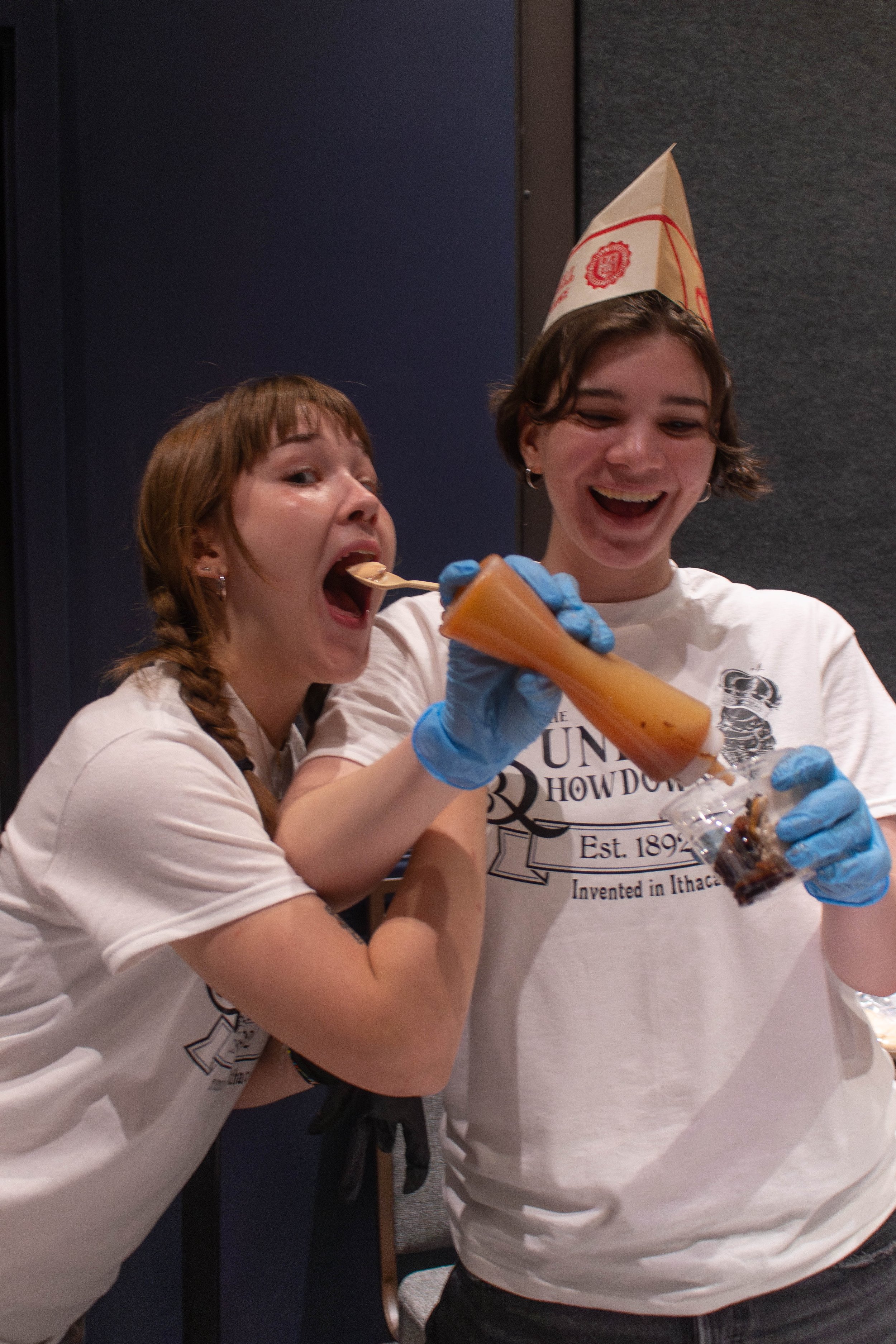
Ithaca College students making history at the very first Sundae Showdown in 2025
This May, The History Center invites you to taste the history of Tompkins County by joining us for the Sundae Showdown. We'll celebrate the invention of the ice cream sundae and all of the culture surrounding it with a tasteful competition. Try the sundae's, explore the artifacts, and vote on who should be crowned champion for this year's recipe contest.
Researched by Eve Snyder PhD, Historian, and Edited by BrierMae Ossont, Community Engagement Manager
1. “John H Tyler,” HistoryForge, accessed April 4, 2026, https://tompkins.historyforge.net/people/16313.
2. "Black Diamond Ice Cream," Ithaca Daily News, September 20, 1897, 4.
3. Ithaca City Directory, 1905–1925.
4. "Chacona's Advertisement," Ithaca Daily News, February 25, 1910, 3.
5. "Notice," Ithaca Journal, September 12, 1916, 5; "To Our Customers," Ithaca Journal, September 13, 1916, 3.
6. "New Ice Cream Plant Will Open Tomorrow," Ithaca Journal-News, September 24, 1925, 7.
